
Georgian Wine Regions Explained: Kakheti, Imereti, Racha and More
Ask someone to name a French wine region and they'll probably manage Bordeaux or Champagne without blinking. Ask about Georgia, and most people, even wine lovers, draw a blank beyond "the country with the clay pots." Fair enough. But Georgia has its own patchwork of distinct wine regions, each with its own grapes, climate, and style, and once you know the map, a lot of what's in your glass suddenly makes a lot more sense.
Here's the region by region breakdown, from the powerhouse in the east to the small, quietly excellent pockets most people never hear about.
Why Region Actually Matters Here
Georgia is officially divided into several viticulture zones, with somewhere around 20 to 29 registered wine appellations depending on how recently the list was updated (new ones are still being added). That's a lot for a country roughly the size of Ireland. The reason it matters: climate, soil, and local grape varieties shift noticeably as you move from the dry east to the humid, Black Sea influenced west, and Georgian winemakers have spent thousands of years figuring out exactly what grows best where.
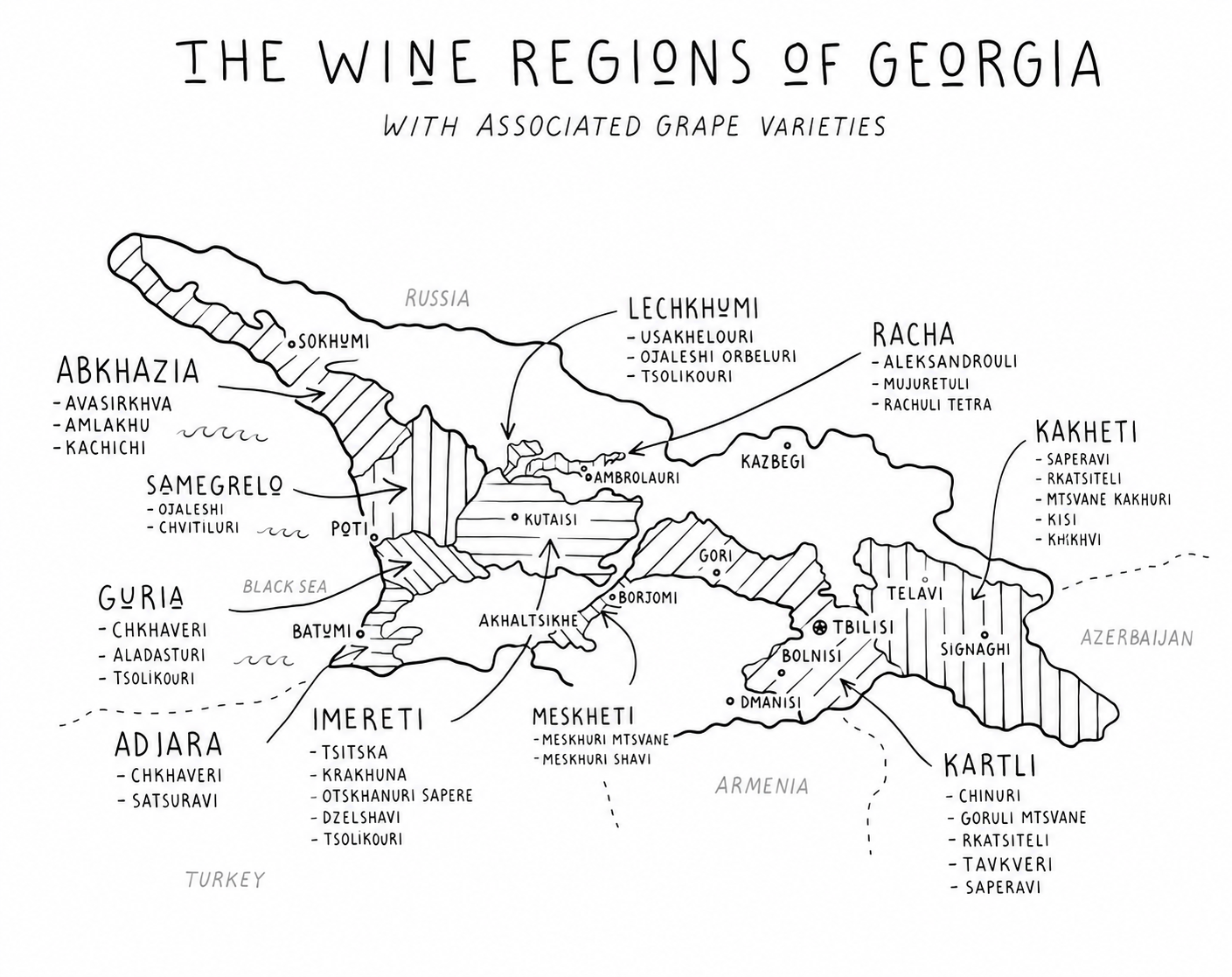
The wine regions of Georgia
Kakheti: The Heavyweight
If Georgian wine has a capital, it's Kakheti. This eastern region, centered on the Alazani Valley and shielded by the Greater Caucasus mountains, produces somewhere between 70 and 80 percent of all Georgian wine, depending on the year and the source you check. It's also home to the majority of the country's officially registered appellations, including well known names like Tsinandali, Mukuzani, Napareuli, and Kindzmarauli.
The signature grapes here are Rkatsiteli, one of the most widely planted white grapes on the planet even if most people have never heard of it, and Saperavi, a red grape so deeply pigmented it's nicknamed "black wine." Kakheti is also the heartland of the classic qvevri method: long maceration, whole clusters, months of skin contact, producing the bold amber whites and structured reds the country is best known for internationally.
Telavi, the regional capital, is often called Georgia's wine capital, and nearby Sighnaghi, perched above the Alazani Valley, is worth the detour for the view alone.
Imereti: The Gentler Cousin
West of Kakheti, on the other side of a mountain pass, Imereti does things a little differently. It's Georgia's second most important wine region by volume, but the wines that come out of it feel like a different conversation entirely.
Imeretian qvevri winemaking uses a lighter touch than Kakheti's: less skin contact, no stems, and typically no more than a third of the grape solids in the mix. The result is rounder, less tannic amber wine with a softer texture and a bit more lift. The signature white grape is Tsolikouri, often blended with Tsitska and Krakhuna, and the region also preserves rarer varieties like Otskhanuri Sapere, a red almost nobody outside Georgia has tasted.
If Kakheti amber wine is a bold statement, Imereti's version is the more approachable, food friendly cousin.
Racha-Lechkhumi: Small, Mountainous, and Semi-Sweet
Tucked into the foothills of the Greater Caucasus, Racha-Lechkhumi is one of Georgia's smallest wine regions by area, and one of its most distinctive by reputation. This is the home of Khvanchkara, a naturally semi-sweet red made from two grapes, Aleksandrouli and Mujuretuli, that barely grow anywhere else. Khvanchkara has a long-running reputation as a favorite of Soviet leader Joseph Stalin, who was born not far from here in Gori, a story repeated often enough in Georgia that it's practically part of the label.
Don't mistake "semi-sweet" for simple, though. Good Khvanchkara balances its natural sweetness with real acidity and structure, which is exactly why it survived Soviet mass production largely intact while dozens of drier, more delicate styles from other regions were sidelined in favor of easier, sweeter wine for the Russian market.
Kartli: The Region Around the Capital
Central Georgia's Kartli region, split into Shida (inner) and Kvemo (lower) Kartli, surrounds Tbilisi itself and is currently one of the more interesting comeback stories in the country. Historically home to royal vineyards, Kartli has increasingly become known for something Georgia isn't traditionally associated with at all: sparkling wine. The Atenuri appellation, made from Chinuri and Goruli Mtsvane grapes, is Georgia's answer to traditional method sparkling wine, and it's genuinely worth seeking out.
Kartli is also more open to international grape varieties than most other Georgian regions, with small plantings of Chardonnay, Sauvignon Blanc, and Merlot alongside its native Chinuri, Goruli Mtsvane, and Shavkapito.
And a Few More Worth Knowing
Georgia's wine map doesn't stop at those four. A handful of smaller western and coastal regions round it out, each with its own quiet specialty:
Guria, a small region near the Black Sea coast, is known for Chkhaveri, a delicate, pale red grape often made into a light, almost rosé style wine.
Samegrelo, further along the coast, is the home of Ojaleshi, a red grape capable of producing genuinely age-worthy wine, though production remains small.
Adjara, Georgia's subtropical southwest corner around Batumi, grows mostly Tsolikouri in a warmer, more humid climate than anywhere else in the country.
Abkhazia, in Georgia's northwest, has a long winemaking history of its own, though current political circumstances make its wine far harder to find internationally.
None of these regions will ever rival Kakheti in volume, but they're exactly where a lot of the more surprising, harder to find bottles come from, and exactly why "Georgian wine" is a much bigger category than most newcomers expect.
A Quick Way to Remember It
If you want the short version: Kakheti is bold and amber, Imereti is lighter and rounder, Racha is semi-sweet and mountainous, Kartli is central and increasingly sparkling, and the smaller western regions each guard a single grape variety you're unlikely to find anywhere else on earth.
Explore the Regions Bottle by Bottle
The easiest way to actually learn this map is to taste your way across it. Browse our collection of Georgian wines, sourced directly from small wineries across these regions, or read about the individual wineries we work with to see exactly where in Georgia each bottle comes from. If you're still getting familiar with the qvevri method itself, our beginner's guide to qvevri wine is a good place to start first.
FAQ: Quick Answers About Georgian Wine Regions
-
Kakheti, by a wide margin. It accounts for roughly 70 to 80 percent of the country's total wine production and is home to most of Georgia's officially registered appellations.
-
Kakheti uses long skin contact with whole clusters, producing bold, tannic amber wines. Imereti uses shorter contact, no stems, and less grape solid, producing lighter, rounder amber wines.
-
A naturally semi-sweet red wine from the Racha region, made from the Aleksandrouli and Mujuretuli grapes, both nearly exclusive to that area.
-
Yes. The Kartli region, particularly the Atenuri appellation, produces traditional method sparkling wine from Chinuri and Goruli Mtsvane grapes.
-
Georgia is generally described as having around six to twelve broad viticulture zones, with somewhere between 20 and 29 more specific registered appellations within them, and the list continues to grow as more are officially recognized.ption
